

Aims and Scope
The Brazilian Journal of Health Aromatherapy and Essential Oil (BJHAEO) (ISSN 2965-7253) is an international, open-access, peer-reviewed scientific journal published in continuous flow, dedicated to the dissemination of high-quality research in the field of health sciences, encompassing basic, clinical, translational, and applied investigations related to human health, disease processes, prevention, care, and health promotion.
BJHAEO positions itself as a multidisciplinary and integrative scientific journal in health, welcoming contributions from all areas of health and biomedical sciences, including, but not limited to: medicine, nursing, pharmacy, physiotherapy, nutrition, psychology, dentistry, biomedicine, public health, basic and translational sciences, health technologies, health education, and evidence-based integrative practices.
The journal values scientific approaches that connect different levels of investigation—from the molecular to the population level—promoting dialogue between conventional biomedical research, integrative strategies, technological innovation, and contemporary models of health care. In this context, studies involving natural substances, bioactive compounds, integrative interventions, and their impacts on health may be considered, provided they are grounded in rigorous scientific methodology and appropriate academic framing.
The Scope of the Journal Includes (but is not limited to):
- Basic, Biomolecular, and Physiological Sciences
Experimental studies on cellular, molecular, biochemical, and physiological mechanisms related to health, disease, and biological responses to different therapeutic interventions. - Clinical and Translational Research
Clinical trials, observational studies, translational research, and evidence-based clinical investigations across different health specialties, including the evaluation of therapeutic interventions, care strategies, prevention, and rehabilitation. - Public Health, Epidemiology, and Health Systems
Research focused on population health, health promotion, disease prevention, epidemiology, public policies, health system organization, and implementation science. - Pharmacology, Toxicology, and Safety Assessment
Studies related to pharmacological mechanisms, safety, toxicology, interactions, risk assessment, and the rational use of substances and therapeutic interventions. - Innovation, Technology, and Emerging Methods in Health
Research integrating health with technology, data science, artificial intelligence, digital health, diagnostic and therapeutic methods, and innovative models of health care delivery. - Education, Professional Training, and Knowledge Translation in Health
Studies addressing health education, professional training, curriculum development, pedagogical practices, scientific communication, and knowledge dissemination strategies. - Integrative Practices and Evidence-Based Complementary Approaches
Scientific investigations of integrative and complementary practices, including aromatherapy and the use of essential oils, when analyzed through critical, methodological, and evidence-based perspectives. - Traditional and Intercultural Knowledge in Health (scientifically contextualized)
Analyses of traditional knowledge and cultural practices related to health, provided they are framed within scientific, historical, or critical approaches, avoiding empirical bias or non-scientific interpretations.
Editorial Standards and Scientific Rigor
BJHAEO strictly adopts international standards of scientific publishing and research ethics. All manuscripts undergo a double-blind peer-review process, ensuring impartiality, methodological quality, and scientific integrity. The journal follows the ethical guidelines of the International Committee of Medical Journal Editors (ICMJE) and requires compliance with principles of research ethics, responsible authorship, disclosure of conflicts of interest, and data transparency.
The journal prioritizes original, methodologically sound, and scientifically relevant contributions to the advancement of health sciences, avoiding promotional language, commercial bias, or approaches lacking scientific support.
Types of Articles Accepted
- Original Articles
- Review Articles and Mini-Reviews
- Case Reports
- Clinical Images
- Experience Reports (with scientific framing)
- Medical Hypotheses
- Letters to the Editor (Correspondence and Comments)
International Reach and Inclusivity
BJHAEO encourages submissions from researchers from all regions of the world, representing different health systems, cultural contexts, and scientific traditions. The journal promotes international collaboration, academic diversity, and knowledge exchange through a neutral, ethical, and global editorial perspective.
Scientific Mission
The mission of BJHAEO is to contribute to the advancement of health sciences through the dissemination of rigorous, interdisciplinary, and ethically grounded scientific knowledge, promoting integration among research, clinical practice, education, innovation, and public health at a global level.
If you have any questions, please do not hesitate to contact us at bjharomatherapyessentialoil@gmail.com.
Current Issue
Vol. 3 No. 1 (2026): January to December - 2026
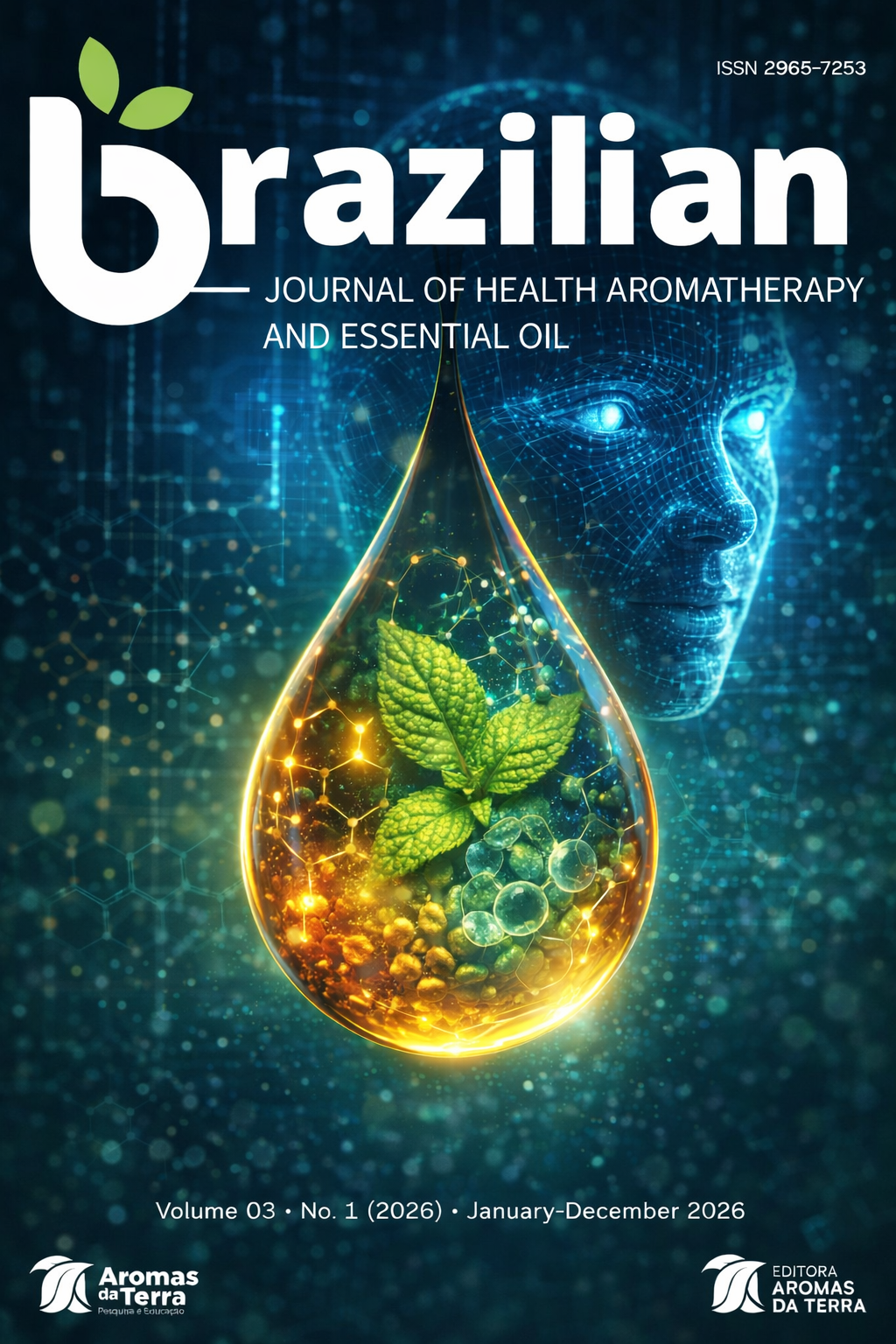
In the 2026 edition, we open with the Editorial entitled “Essential Oils at the Interface of Nature, Technology, and Human Health”, a reflection that mirrors both the scientific direction of this issue and the symbolic depth expressed on our cover. The image of a human face interwoven with digital networks and a luminous drop containing botanical elements represents the core mission of this journal, which is to bridge traditional natural knowledge with modern scientific and technological advances.
This editorial explores how aromatherapy and essential oil research have evolved into a truly integrative science that connects molecular biology, neuroscience, inflammation, metabolism, and clinical practice. It highlights the growing body of evidence demonstrating that essential oils are not merely complementary tools, but biologically active agents capable of interacting with complex physiological systems through well-defined mechanisms.
Special emphasis is placed on the convergence between innovation and scientific rigor. Advances in analytical chemistry, omics technologies, digital health tools, and translational research models are reshaping how essential oils are studied, validated, and applied. The editorial reinforces the need for methodological robustness, reproducibility, and ethical standards, ensuring that scientific progress remains aligned with safety, efficacy, and professional responsibility.
Finally, this edition underscores the importance of interdisciplinary collaboration by bringing together researchers, clinicians, pharmacists, and health professionals with the goal of transforming essential oil science into meaningful health solutions. By integrating nature-derived compounds with cutting-edge science, this journal continues to support the maturation of aromatherapy as a field that is both scientifically grounded and clinically relevant in contemporary global healthcare.
Published: 2026-01-15
Health Review and Mini-Review
Edited by: 
Registered in: 